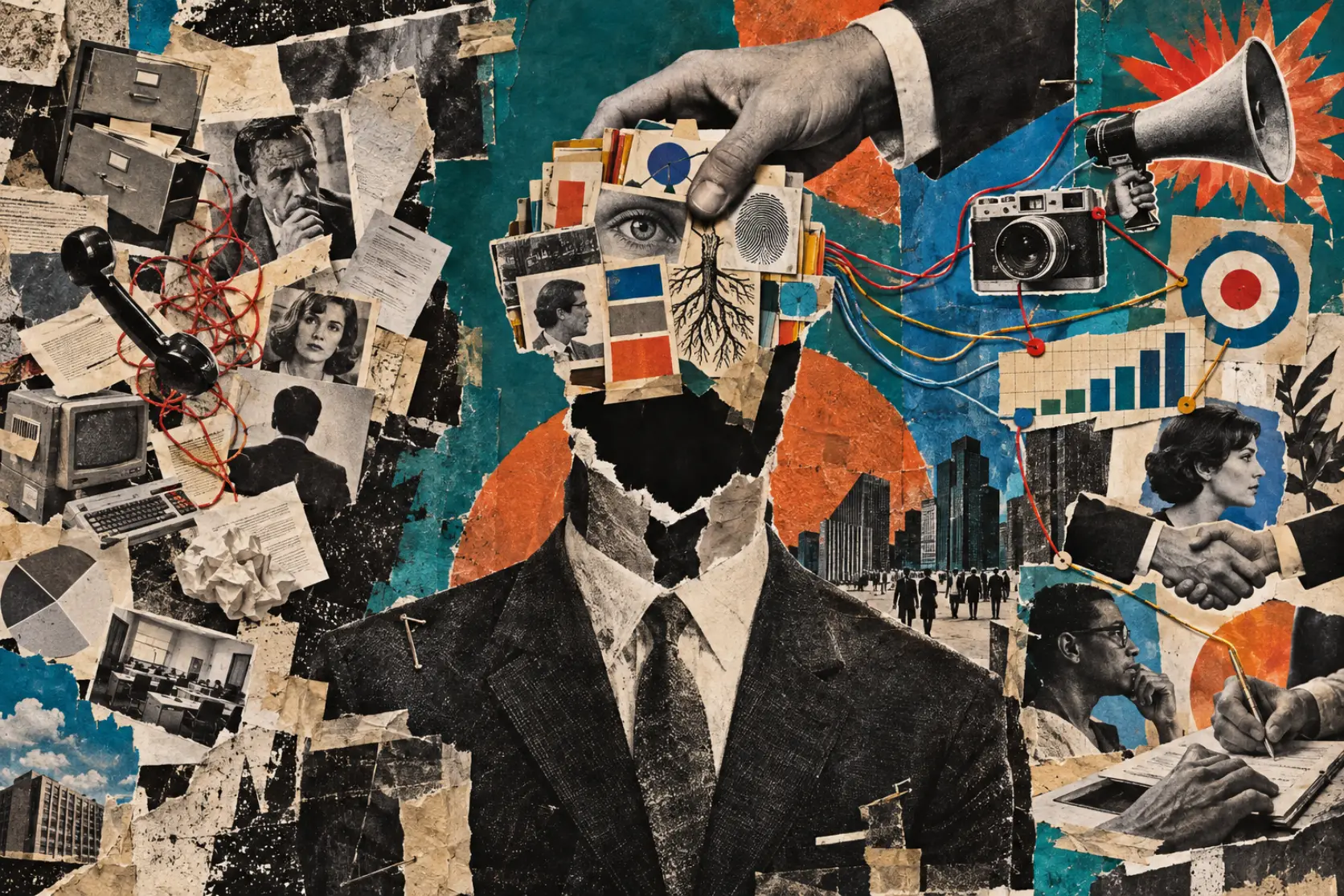
Your CRM remembers your contacts.
Your shared drive remembers your files.
Slack remembers thousands of conversations nobody will read again.
Your founder remembers why the company made certain choices. Your salespeople remember what buyers object to. Your customers remember the promises you made.
But does the company know any of it?
That is a different question.
Most businesses have enormous amounts of memory and no brain. They have places where information is stored, but no agreed system for deciding what is current, what is true, what the company believes and what should happen next.
This was inconvenient when people were doing most of the work.
It becomes dangerous when AI can act on the confusion at scale.
We are connecting machines to companies that cannot explain themselves
In my last essay, “Marketing Engineering Will Be the Hottest Job of the Next Five Years”, I wrote about Greg Isenberg’s argument that the people who can connect customer signals, AI agents, experiments and revenue will become extraordinarily valuable.
I agree with him.
I also think marketing engineering exposes a problem most companies have been able to avoid.
What is the machine supposed to believe?
Your website describes one customer. The sales deck describes another. The proposal template still includes an offer you retired last year. The founder has a sharp point of view that never made it into the brand guide. Three salespeople explain the company’s difference in three different ways.
Now connect an AI agent to all of it.
The agent does not discover the truth hiding in the pile. It finds patterns, resolves contradictions as best it can and produces a confident answer.
Then another agent builds a campaign from that answer. Another writes a landing page. Another sends follow-up emails. Another produces fifty social posts.
You have given the company a nervous system before giving it a brain.
It can move. It can react. It can produce. It has no stable identity guiding the movement.
A company brain is not a giant folder
Putting every file in one place is useful. It is not the same as creating a brain.
A brain needs to do more than store information. It needs to create meaning.
For a company, that means being able to answer:
- Who are we for?
- What are those people trying to change?
- What do we believe about the problem?
- Why did we choose this way of solving it?
- What can we prove?
- Which language and visual choices feel like us?
- What are we still testing?
- What must we never claim without evidence or approval?
The answers should not be flattened into one voice-of-God document that pretends the company is certain about everything.
A useful brain distinguishes between facts, beliefs, evidence, decisions and ambitions.
It can say, “This is what we know.”
It can also say, “This is what we believe, and here is why,” or, “This is the direction we are testing, but it is not yet a proven claim.”
That distinction is what makes the source trustworthy.
The AI Brand Twin is the identity layer
At PitchKitchen, we call the identity layer of this brain the AI Brand Twin.
It begins with the Magnetic Messaging Framework: the customer problem, the company’s beliefs, the distinction in its approach, the evidence behind its claims and the language that makes the story usable.
It also needs the visual identity. Not only the logo and color values, but the principles that explain why certain images, compositions and experiences belong to the company while others contradict it.
The AI Brand Twin gives the machine a coherent answer to a deceptively simple question:
Who are you representing?
We learned how important that question was through three versions of the product.
First, we built Custom GPTs loaded with a client’s messaging. They were useful, but the identity lived inside a particular tool.
By the end of 2025, we had moved the Brand Twin into a portable Markdown document. A client could place it in a shared Claude Project or ChatGPT Space. The company owned the source, and the team could use it across more of its work.
That solved the portability problem. It did not solve the copy problem.
Every project, person and platform could still end up with a different version.
MCP is the access layer
In August 2026, we launched the PitchKitchen AI Brand Twin over MCP.
MCP, or Model Context Protocol, gives compatible AI tools a standard way to retrieve approved context and capabilities.
For the company brain, the practical change is simple.
A shared project gives a group of people a copy of the brain.
MCP gives connected tools access to the current brain.
The company can update its positioning, customer definition or evidence once. ChatGPT, Claude, Cursor and other approved tools can then retrieve the current version when they need it.
MCP does not create the truth. It does not decide which claim is defensible. It does not resolve a disagreement between the founder and the sales team.
It is plumbing.
Good plumbing matters. It moves the right source to the point of use without asking everyone to carry buckets or remember which copy is current.
But there still has to be something worth moving.
Marketing engineering is how the brain learns
This is where marketing engineering becomes more than an impressive automation stack.
A marketing engineer connects signals to action.
A pattern appears in sales calls. The marketing engineer compares it with the current customer story. They build a page or campaign to test the insight. The result comes back. A human decides whether the result was noise, a local exception or evidence that the company’s understanding should change.
The learning loop looks like this:
- Listen. Capture customer language, objections, behavior and market changes.
- Interpret. Compare the signal with what the company currently believes.
- Experiment. Build something specific enough to test the interpretation.
- Measure. Observe what happened without pretending every metric proves causation.
- Decide. Use human judgment to determine what the company should do next.
- Update. Change the approved source when the evidence warrants it.
Without the final two steps, the company has automation, not learning.
This is the part people miss when they describe an AI system that gets smarter over time.
The system should not update its own identity because one ad performed well or one customer used a surprising phrase. A result is evidence to review. It is not automatically a new company truth.
The company brain needs a steward.
The brain should have boundaries
A useful company brain is not open to every employee, agent and vendor in exactly the same way.
Some parts should be broadly available: the customer story, approved claims, brand principles, current offers and standard operating guidance.
Some parts require narrower access: customer records, pricing exceptions, confidential strategy, employee information and work that is still under discussion.
The system should know the difference between reading, proposing and changing.
An agent may be allowed to read the current Brand Twin and draft a campaign. It should not be allowed to change the Brand Twin because it wrote a sentence it liked.
A salesperson may propose a new objection for the knowledge base. Someone still needs to review whether it is a recurring pattern and how it changes the story.
Governance can sound bureaucratic. In practice, it is what keeps speed from turning into drift.
A one-hour test for your company
You do not need an MCP server to find out whether your company has a brain.
Choose four participants:
- The founder or business leader.
- Someone in sales.
- Someone in marketing or delivery.
- The AI system your team uses most often.
Ask each one the same five questions:
- Who is our best customer?
- What are they struggling to change?
- What do we believe that our competitors do not?
- What proof supports our most important claim?
- What should we never say or promise?
Compare the answers.
If you receive four versions of the company, you do not have a prompt problem.
You do not have an AI problem.
You have a missing brain.
That is useful news, because now you know what to build.
Start with the narrative identity. Separate truth from ambition. Attach evidence to claims. Connect the visual principles. Choose the current source. Give the right people and tools access. Assign someone to keep it alive.
Then build the agents.
Then hire the marketing engineer.
Give the nervous system something worth listening to.
Continue reading
- Greg Rosner, “Marketing Engineering Will Be the Hottest Job of the Next Five Years. But First, Build the Brain.”
- PitchKitchen, AI Brand Twin over MCP
- Greg Isenberg, “Making $$$ as a Marketing Engineer”, The Startup Ideas Podcast, August 31, 2026.